Cloud Infrastructure Management

By admin , 2 March 2026
Listing Image
Teal
Article Body
Title

Reactive Cloud Operations in a Proactive World

Description

As organizations accelerate their adoption of hybrid cloud and multi-cloud infrastructure models, infrastructure management must evolve from a reactive, incident-driven approach to a proactive cloud infrastructure management strategy focused on resilience, performance optimization, cybersecurity, cost control, and measurable business value.
 

The Core Challenge: Reactive Cloud Operations in a Proactive World


Despite significant investments in cloud computing, virtualization, and infrastructure modernization, many organizations still operate in reactive mode. Cloud operations teams spend a large portion of their time resolving incidents instead of anticipating performance degradation, capacity constraints, or security vulnerabilities, which limits their ability to support digital transformation, scalability, and business growth.


In complex enterprise cloud infrastructure environments, reactive management increases operational risk, technical debt, and service disruption exposure.


A Shift in Mindset: From Reactive Operations to Proactive Hybrid Cloud Infrastructure Management


Proactive hybrid cloud infrastructure management treats cloud infrastructure as a strategic asset rather than a technical utility. It requires end-to-end visibility across on-premise infrastructure, private cloud, and public cloud platforms, supported by strong operational governance and advanced observability capabilities.


Modern cloud infrastructure management frameworks emphasize predictive analytics, automation, capacity planning, performance optimization, and proactive cybersecurity monitoring to anticipate and mitigate risks before they impact business-critical services.


Image
Teal
Title

Practical Approaches and Best Practices in Cloud Infrastructure Management

Items
Description

Defined roles, escalation paths, and structured decision-making processes reduce ambiguity and improve responsiveness in hybrid cloud environments. Mature cloud governance models improve operational efficiency and reduce escalation cycles and decision latency, strengthening overall cloud infrastructure resilience.

Title
Strong cloud governance and clear ownership
Layout
Full Width
Description

Beyond real-time alerts, advanced cloud observability tools analyze performance patterns, infrastructure utilization, workload behavior, and weak signals to prevent service degradation before users are impacted. IT service disruptions typically represent 5–10% of the annual operational impact within large enterprise IT environments, highlighting the strong business value of predictive monitoring and early detection in cloud infrastructure operations.

Title
Proactive cloud monitoring and trend analysis
Layout
Full Width
Description

Metrics such as cloud service availability, mean time to recovery (MTTR), cybersecurity posture, cost efficiency, and infrastructure scalability provide more strategic value than purely technical indicators. Aligning cloud infrastructure KPIs with business outcomes can significantly reduce reactive incident handling and improve overall service availability and performance stability.

Title
Business-oriented cloud KPIs
Layout
Full Width
Description

Post-incident reviews, systematic root cause analysis, and continuous improvement frameworks are essential to prevent recurring disruptions and improve cloud operations maturity. Organizations with structured cloud incident management practices report a substantial reduction in recurring infrastructure issues and enhanced operational stability.

Title
Structured incident and problem management in cloud environments
Layout
Full Width
Description

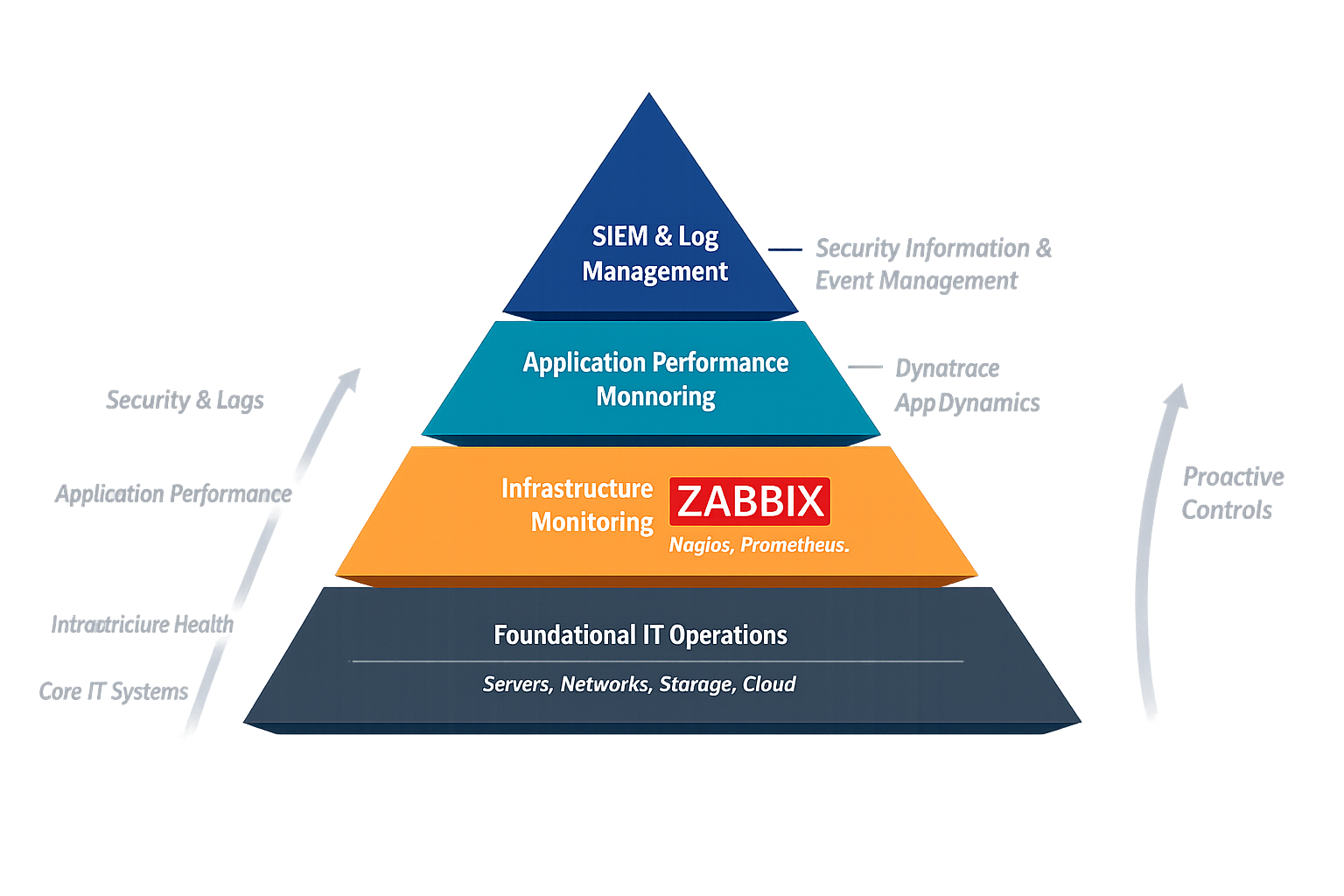
From a tooling perspective, proactive cloud infrastructure management is typically supported by a layered observability and monitoring architecture, integrating cloud monitoring platforms, infrastructure performance management tools, security information and event management (SIEM) systems, and automation frameworks. Each layer addresses specific operational needs across hybrid cloud ecosystems.

The Human-AI Collaboration Model
Title
The Human-AI Collaboration Model
Pillars Wysiwyg

Hybrid cloud success depends on operational maturity, not technology alone, within a well-structured cloud infrastructure strategy.

Proactive cloud infrastructure management reduces operational risk, enhances cybersecurity posture, improves scalability, and strengthens infrastructure resilience.

Monitoring, observability, automation, and cloud security tools must be aligned within a clear hybrid cloud governance framework to deliver sustainable performance excellence.

Text

Hybrid Cloud Infrastructure Management is no longer a purely technical function. It is a strategic enterprise cloud capability that directly influences business performance, operational resilience, cost optimization, and stakeholder confidence in cloud computing environments.

Overline
Conclusion
Read Time
10 min
Formatted Title

From Reactive Operations to Proactive Service Excellence

Text

INTRODUCTION 
 

Over the past decade, cloud infrastructure has become the critical backbone of modern business operations.

Enterprise applications, digital platforms, multi-cloud environments, and remote work ecosystems now depend on the continuous availability, performance, scalability, and security of increasingly complex hybrid cloud infrastructure architectures.

Contributors Section Title
Contributor