Artificial Intelligence

By mmriki , 8 June 2026
Listing Image
From Cybersecurity
Article Body
Title

Building OT Cyber Resilience Through Defense in Depth

Description

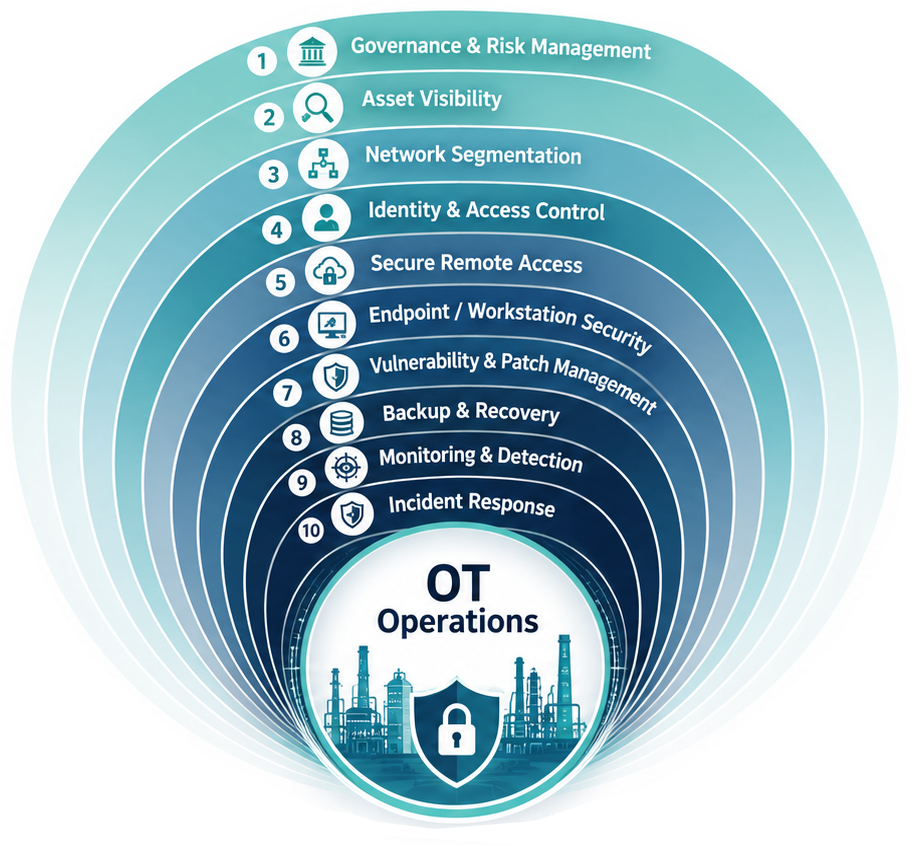
Industrial environments are now more connected. Remote support is frequent, vendors are involved, and threats increasingly target production continuity. OT cybersecurity must therefore move from isolated measures to a structured resilience model.


This is the role of Defense in Depth. The objective is not to create a perfect barrier. The objective is to create coordinated layers so that if one control fails, another can prevent, detect, contain, or reduce the impact of an attack.


In OT, a cyber incident can affect more than data. A compromised engineering workstation can modify controller logic. A weak vendor account can open a path into the plant. Ransomware can stop production. A misconfigured firewall can expose SCADA servers. A missing backup can delay recovery.


This is why OT cybersecurity must combine anticipation, containment, monitoring, and recovery. It must also respect operational reality: legacy systems, vendor technologies, long asset lifecycles, safety requirements, availability constraints, and limited maintenance windows.


Image
Items
Description

Separating IT and OT is still necessary, but the perimeter is no longer enough. Industrial systems now exchange data with historians, cloud platforms, remote vendors, patch servers, backup platforms, and monitoring tools. A mature model combines governance, asset visibility, segmentation, identity, remote access, endpoint protection, vulnerability management, backup, monitoring, and incident response.

Title
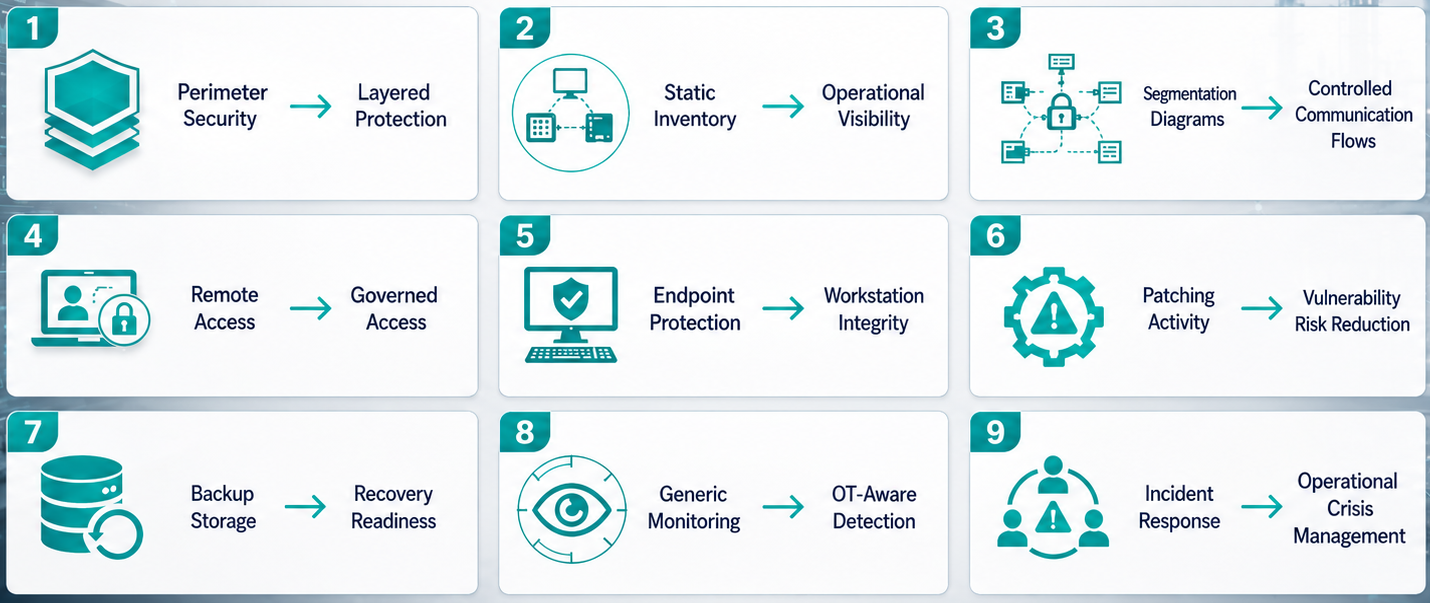
1. From perimeter security to layered protection
Layout
Full Width
Description

An inventory updated once a year cannot support real risk management. Organizations need visibility into connected assets, critical systems, normal flows, obsolete devices, vulnerable systems, engineering workstations, backup status, and monitored assets. Visibility transforms inventory from documentation into a security capability. Without visibility, decisions are based on assumptions. With visibility, they are based on facts.

Title
2. From static inventory to operational visibility
Layout
Full Width
Description

A network diagram does not protect an industrial environment. What matters is controlling which systems communicate, through which protocols, on which ports, and for which purpose. This is critical for SCADA, DCS, PLC networks, safety systems, engineering stations, historians, backup servers, patch servers, remote access platforms, and OT DMZs. The goal is to reduce propagation and limit the blast radius.

Title
3. From segmentation diagrams to controlled flows
Layout
Full Width
Description

Remote access is necessary for vendors, integrators, and internal teams, but it is also a major entry point. It must rely on named users, strong authentication, approvals, time-limited sessions, role-based permissions, jump servers, session recording, logging, access reviews, and SOC monitoring. Remote access must be approved, limited, monitored, and auditable.

Title
4. From remote access to governed access
Layout
Full Width
Description

Operator and engineering workstations are highly sensitive because they operate processes and modify controller logic. Protecting them requires more than antivirus. It requires control over administrator rights, USB usage, boot sequence, BIOS settings, application installation, OS hardening, patch levels, golden images, backups, physical access, change management, and security logging. The goal is to preserve the integrity of the industrial function.

Title
5. From endpoint protection to workstation integrity
Layout
Full Width
Description

Patching in OT is difficult because vendor validation, compatibility, rollback, safety, and maintenance windows must be considered. Vulnerability management should focus on risk reduction, not only patch deployment. Depending on the case, the right action may be to patch, isolate, monitor, restrict access, disable a service, or apply virtual patching.

Title
6. From patching to vulnerability risk reduction
Layout
Full Width
Description

Having backups does not guarantee recovery. The real question is whether the organization can restore the right systems, in the right order, within the required time, without additional risk. Recovery must cover servers, workstations, PLC programs, DCS configurations, safety logic, firewall rules, switch configurations, HMI projects, licenses, and documentation. Backups must be tested and procedures documented.

Title
7. From backup storage to recovery readiness
Layout
Full Width
Description

OT monitoring requires industrial context. A new RDP session, PLC programming activity, or communication change may be normal during maintenance but critical during production. Detection should focus on unauthorized engineering activity, remote access anomalies, controller logic changes, abnormal protocol behavior, lateral movement, firewall events, malware alerts, backup failures, patch failures, and configuration changes.

Title
8. From generic monitoring to OT-aware detection
Layout
Full Width
Description

An OT cyber incident can quickly become a production crisis. Response must involve cybersecurity, operations, maintenance, engineering, management, vendors, and communication teams. A strong plan defines leadership, escalation, vendor coordination, isolation authority, production decisions, restoration validation, executive communication, evidence handling, and restart approval.

Title
9. From incident response to crisis management
Layout
Full Width
Description
Title
OT Cybersecurity Maturity Roadmap
Pillars Wysiwyg

The future of OT cybersecurity will be defined by organizations that understand their assets, control their flows, govern access, monitor operations, and prepare recovery.

Text

Defense in Depth is not a technology stack, a checklist, or an accumulation of products. It is a structured way to protect industrial operations through coordinated and realistic layers.


Overline
Conclusion
Read Time
10 min
Formatted Title

Rethinking Defense in Depth for OT Environments

Text

INTRODUCTION 
 

For years, OT cybersecurity was treated as a list of controls: firewalls, antivirus, DMZs, USB restrictions, VPN access, and backups. These controls are useful, but they are not enough when deployed separately.

Contributors Section Title
Contributor
Inroduction Section Title
INTRODUCTION 
By azaghly , 9 March 2026

The Framework That Transforms Industry into Operational Intelligence

Artificial intelligence and digital technologies are reshaping the industrial landscape. Yet many organizations struggle to transform data, automation, and AI into real competitive advantage. This white paper introduces NIDDAM (Next-Gen Industrial, Digital, Data and AI Model), a comprehensive framework designed to assess digital maturity, structure transformation strategies, and guide organizations toward operational excellence.

This white paper introduces NIDDAM (Next-Gen Industrial, Digital, Data and AI Model), a comprehensive framework designed to assess digital maturity, structure transformation strategies, and guide organizations toward operational excellence. 

In This White Paper
The challenge of digital transformation in industry
Why existing frameworks remain fragmented
The NIDDAM maturity framework (8 domains Ă— 5 dimensions)
The 5-level industrial maturity model
The 6-step transformation methodology
Real industrial transformation use case
Key benefits and measurable ROI of NIDDAM
Key Figures
Description

Improvement achieved after implementing the NIDDAM roadmap.  

Value
+25%
Subtitle
Productivity
Description

Operational quality improvements through data-driven optimization.

Value
-15%
Subtitle
Defects
Description

Reduction in operational disruptions after digital integration.

Value
-40%
Subtitle
Downtime
Image
Name
Mouhsine LAKHDISSI
LinkedIn Profile
https://www.linkedin.com/company/teal-technology-services/
By admin , 10 March 2026
Listing Image
Teal
Article Body
Title

High-profile incidents

Description

Including the massive data breaches attributed to the “Jabaroot” group targeting strategic national institutions such as CNSS and ANCFCC — exposed a hard truth:data security can no longer rely on trust alone.


In response to this crisis of confidence and the urgent need to safeguard critical infrastructure, the Moroccan State — through the Direction Générale de la Sécurité des Systèmes d'Information (DGSSI) — has enacted a strict national Cloud qualification framework governing all Cloud service providers operating with entities of vital importance.


The Countdown Has Begun: What the DGSSI Cloud Framework Requires

This new regulatory framework (Government Decree No. 3-17-25) is not a recommendation — it is a binding legal obligation for any Cloud provider serving critical sectors.

Image
Teal
Title

What the DGSSI Cloud Framework Requires

Items
Description

Demand compliance from your Cloud providers — or rethink your Cloud strategy immediately.

Below are the non-negotiable requirements imposed by the framework:

Requirement

Risk in Case of Non-Compliance

Immediate Action

Data Localization

Loss of digital sovereignty and exposure to foreign jurisdictions for sensitive data.

Verify that your provider guarantees data hosting in Morocco for “Level 2” critical workloads.

Encryption & Access Control

Direct vulnerability to data breaches and unauthorized access.

Require end-to-end encryption and multi-factor authentication (MFA).

DGSSI Qualification

Engagement with unaudited and potentially non-resilient providers.

Ensure your Cloud provider is actively engaged in the DGSSI qualification process.

Risk & Continuity Management

Inability to respond effectively to major cyber incidents.

Integrate business continuity and incident response requirements into contractual agreements.


Compliance is now a strategic governance issue — not merely a technical IT matter.

Title
For enterprises leveraging Cloud infrastructure, the message is clear:
Layout
Full Width
Description

One of the most costly cybersecurity misconceptions is assuming that the Cloud provider is fully responsible for security. The DGSSI framework reinforces the principle of shared responsibility, and ignorance is no longer a valid defense.

Service Model

Provider Secures (Infrastructure Layer)

You Secure (Data & Applications Layer)

IaaS (Infrastructure as a Service)

Physical infrastructure, network, storage

Operating systems, applications, data

PaaS (Platform as a Service)

Infrastructure and runtime environment

Application security, data protection, configuration

SaaS (Software as a Service)

Application, infrastructure, environment

User access management and data governance


Your organization remains accountable for securing what it places in the Cloud.

The new framework elevates this responsibility from best practice to regulatory obligation.

Title
Clarifying the Shared Responsibility Model: Who Secures What?
Layout
Full Width
Description

This regulatory shift represents a pivotal opportunity to professionalize your cybersecurity posture.

Organizations that align early with DGSSI Cloud qualification standards will gain:

  • Enhanced stakeholder trust

  • Stronger digital resilience

  • Competitive advantage in regulated markets

  • Improved governance and risk management maturity


Conversely, delayed compliance exposes businesses to:

  • Escalating cyber threats

  • Legal and regulatory sanctions

  • Reputational damage

  • Loss of strategic partnerships

Title
2026: The Year of Compliance — or the Year of Exposure?
Pillars Wysiwyg

References

Infomédiaire – 21 million cyberattacks detected in Morocco in H1 2025.

Le Matin – Morocco ranked third in Africa among countries targeted by state-sponsored cyberattacks.

CybelAngel – Investigation of the CNSS Data Leak (Flash Report).

CybelAngel – Investigation of the ANCFCC Data Leak (Flash Report).

Le360 – Morocco adopts strict Cloud provider qualification framework.

Text

Immediate action is imperative.

Conduct a comprehensive Cloud security assessment, formally request your provider’s DGSSI qualification roadmap, and reinforce your application and data protection architecture.

The 2026 compliance deadline is not a distant milestone — it is a strategic inflection point.

Overline
Conclusion
Read Time
10min
Formatted Title

Is Your Organization Ready for Morocco’s 2026 Cloud Compliance Turning Point?

Text

INTRODUCTION 
 

The time for wait-and-see strategies is over: Morocco’s new DGSSI Cloud regulatory framework mandates immediate compliance.

2025 marked a decisive wake-up call for Morocco’s IT ecosystem. With over 21 million cyberattacks detected in the first half of the year, and Morocco ranking as the third most targeted African country by state-sponsored cyberattacks, the threat landscape has shifted from theoretical to critical.

Contributors Section Title
Contributor
Inroduction Section Title
INTRODUCTION 
By azaghly , 6 March 2026
Listing Image
Industrial Communication Protocols
Article Body
Title

From Deterministic Control to Networked Automation

Description

In industrial environments, communication has never been a secondary concern. It directly affects operational safety, production continuity, and product quality within complex industrial automation systems. Early industrial protocols such as Modbus RTU, PROFIBUS DP, CAN, ControlNet, and DeviceNet were developed for closed, isolated systems where robustness and determinism were paramount. Data volumes were limited, but timing was critical; messages had to arrive predictably and without ambiguity to ensure safe process automation.


This strict requirement for determinism explains why industrial automation networks remained separated from traditional IT systems for decades. Reliability was not just a technical feature; it was an operational necessity supporting mission-critical industrial control systems

Image
Industrial Communication Protocols
Description

The adoption of Industrial Ethernet marked a fundamental shift in industrial communication architecture and the evolution of industrial automation and control systems. Protocols such as PROFINET, EtherNet/IP, EtherCAT, and POWERLINK combined real-time performance with standardized Ethernet technologies aligned with broader digital transformation in industry initiatives.

This convergence enabled scalable network designs, seamless integration with SCADA, DCS, OMS, and APC systems, and improved diagnostics and maintainability within large-scale industrial automation systems. As a result, industrial networks transitioned from simple control buses to complex, data-rich infrastructures capable of supporting intelligent automation strategies.

Title
The Rise of Industrial Ethernet and IT/OT Convergence
Title

Communication evolved from a control-only function into a structured and strategic source of operational data contributing to emerging industrial intelligence.

Items
Description

Modern industrial environments demand more than fast and reliable data exchange. They require contextualized, interoperable, and secure information flows capable of powering smart industrial systems. Protocols such as OPC UA address these needs by introducing object-oriented data models, platform independence, and built-in cybersecurity mechanisms designed for next-generation industrial automation systems.

By transforming raw signals into meaningful information, industrial communication protocols now support advanced analytics, predictive maintenance, energy optimization, and digital twins. In this context, communication networks are no longer passive carriers; they actively enable industrial intelligence embedded within industrial automation and control systems.

This transition marks a shift from basic connectivity toward communication architectures aligned with Industry 4.0 principles.

Title
From Data Transport to Information Intelligence
Layout
Full Width
Layout
Full Width
Description

With increased connectivity comes increased exposure to cyber threats. Today’s industrial communication protocols must incorporate authentication, encryption, access control, and continuous monitoring to protect interconnected industrial control systems.

Cybersecurity is no longer an add-on but a fundamental design requirement within modern industrial automation systems. A modern industrial protocol is evaluated not only by its performance and reliability, but also by its ability to protect critical assets and ensure long-term operational resilience in the era of digital transformation in industry.

Title
Cybersecurity as a Core Design Principle
Layout
Full Width
Layout
Full Width
Pillars Wysiwyg

These protocols now serve as the digital backbone of smart industrial systems, enabling data-driven operations, enhanced process automation, and sustainable industrial performance. They are fundamental components of advanced industrial automation systems supporting industrial intelligence and intelligent automation strategies.

Choosing the right communication protocol has become a strategic decision, shaping an organization’s ability to innovate, secure its operations, and compete in an increasingly digital landscape defined by Industry 4.0.

Text

The evolution of industrial communication protocols mirrors the broader transformation of the industrial world from isolated, deterministic control systems to interconnected, intelligent ecosystems powered by industrial automation and control systems.

Overline
Conclusion
Read Time
7 min
Formatted Title

From Reliability to Digital Intelligence

Text

INTRODUCTION 
 

Industrial communication protocols have long been designed with a single dominant objective: ensuring reliable, deterministic data exchange between industrial assets within industrial automation and control systems

Today, driven by Industry 4.0 and digital transformation in industry, these protocols are evolving into strategic enablers of data intelligence, interoperability, and secure connectivity across industrial automation systems.

This article examines how industrial communication protocols have progressed from basic reliability mechanisms to key foundations of digitally intelligent industrial control systems and smart industrial systems.

Contributors Section Title
Contributor
Inroduction Section Title
INTRODUCTION 
By azaghly , 6 March 2026
Listing Image
Why digital projects fail before they start
Article Body
Title

The illusion of a smooth start:

Description

At the beginning of a digital transformation project, there is strong pressure to align quickly. Define the scope fast, offer an attractive price, commit to an ambitious timeline and start development immediately to demonstrate rapid digital progress.


It feels dynamic, commercial and efficient, but sometimes, what looks like momentum is actually fragility within the digital strategy and delivery model.


An unclear scope, artificially modest pricing, and an ambitious timeline detached from real technical and integration dependencies are all ingredients for a well-organized failure in enterprise digital projects. On paper, the project starts beautifully but in reality, structural risk has already been introduced into the digital delivery lifecycle

Image
Title

The digital delivery lifecycle

Items
Description

Proper project scoping isn’t about listing features, it’s about defining boundaries, complexity, dependencies, and assumptions within the digital architecture and transformation roadmap.

When scoping is incomplete, hidden technical constraints remain undiscovered, integration complexity is underestimated, data ownership is unclear and governance flows are not validated across digital systems and platforms.

Every vague area in the scope becomes a future negotiation, and negotiations during delivery are never comfortable in digital transformation programs. A project cannot be agile if its foundations are unclear from a digital governance and architecture perspective.

Title
When scoping is optimistic instead of precise:
Layout
Full Width
Description

This is a common pattern in digital projects and digital consulting engagements. To build trust or secure the deal, pricing is sometimes set lower than real complexity requires in complex digital transformation initiatives.

The intention is positive:
“We’ll make it work.”
“We’ll optimize internally.”
“It’s fine, we’ll manage.”

But digital transformation does not reward structural underestimation in digital execution environments. If pricing is not aligned with scope reality, teams start under pressure, scope becomes a battlefield, change requests multiply and quality risks increase across the digital project lifecycle.

What started as a commercial gesture turns into frustration on both sides, because in the end, clients don’t remember the attractive price, they remember the tension experienced throughout the digital delivery process.

Title
The pricing trap: attractive but unrealistic:
Layout
Full Width
Description

One of the most overlooked causes of digital project failure is a weak or skipped Sprint 0 in digital transformation projects. Sprint 0 is not administrative overhead, it’s where technical reality meets strategic ambition and where digital architecture decisions are validated.

This phase is an opportunity to validate architecture choices, integration patterns, API availability, security constraints, and data readiness before full-scale digital implementation begins. I have seen integration work delayed simply because Swagger documentation for APIs was not available at the start of a digital transformation program.

Development teams were ready, business was aligned, but without proper API definition and validation, integration became guesswork… And guesswork in digital projects always costs time and increases digital transformation risk exposure.

A rushed Sprint 0 creates invisible technical debt before the first sprint even begins within the digital delivery framework.

Title
The underestimated power of Sprint 0:
Layout
Full Width
Description

Fast timelines are reassuring, but ambitious planning that ignores API maturity, environment readiness, decision cycles, validation committees, and integration dependencies… Isn’t efficiency in digital project management. It’s deferred disappointment in digital transformation execution.

Speed without structural clarity simply moves the problem into the future, and the future always comes faster than expected in complex digital ecosystems.

Title
The timeline illusion:
Layout
Full Width
Description

Strong decision-making in digital projects is not about moving fast, it’s about moving consciously within a structured digital governance model.

Before execution begins, leaders should ask themselves:
• Is the scope truly understood from a digital architecture standpoint?
• Is pricing aligned with real effort in the digital transformation roadmap?
• Has Sprint 0 validated technical feasibility for the digital solution?
• Are dependencies identified across digital platforms and systems?
• Are assumptions explicit within the digital strategy?

A delayed but robust decision is healthier than a fast but fragile one in digital transformation programs.

Title
Why structured decision-making matters:
Description

Projects that succeed are not necessarily simpler; they are structurally stronger because their digital foundations are validated early.

They:

  1. Protect the scoping phase: they allow refinement instead of rushing to build digital solutions prematurely .
  2. Respect Sprint 0 as a strategic investment: they validate APIs, integrations, environments, and architecture before committing to delivery in digital transformation initiatives .
  3. Price based on reality, not optimism: commercial attractiveness does not override feasibility in digital consulting and execution .
  4. Align ambition with governance and constraints: planning reflects real dependencies within the digital ecosystem .
  5. Surface uncomfortable truths early: it’s better to recalibrate before signing than to renegotiate trust later in a digital transformation journey .

Digital transformation does not fail because teams lack talent. It fails when early clarity is sacrificed for early comfort in digital strategy and project governance .

  • When scope is blurred to accelerate alignment in digital initiatives .

  • When pricing is softened to secure approval of a digital transformation program .

  • When timelines are compressed to create excitement around digital innovation .

  • When Sprint 0 is rushed to show momentum in digital delivery .

These decisions feel harmless at the beginning of a digital transformation project . They are rarely harmless in the end.

Title
What successful digital projects do differently:
Pillars Wysiwyg

In digital projects, what is avoided upfront always resurfaces later, usually under more pressure, higher cost, and lower trust within the digital transformation journey.

Investing in clarity at the start isn’t slowing down a project. It’s protecting its success and ensuring sustainable digital transformation outcomes.

Text

Digital projects rarely collapse because of one dramatic mistake. They erode because of small compromises made too early in the digital transformation lifecycle. And unfortunately, optimism isn’t a delivery strategy in digital project management.

Overline
Conclusion
Read Time
10min
Formatted Title

The Critical Role of Scoping and Decision-Making

Text

INTRODUCTION 
 

The critical role of scoping, pricing and decision-making in digital transformation and digital project management

When we talk about digital project failure, most people think about execution problems such as delays, technical bugs, or lack of adoption. But many digital transformation projects fail long before delivery begins. They fail during scoping, pricing, early decision-making, and very often during a neglected or rushed Sprint 0 in digital project management frameworks. And ironically, they often fail because everyone was trying to be helpful and accelerate digital execution.

Contributors Section Title
Contributor
Inroduction Section Title
INTRODUCTION 
By azaghly , 6 March 2026
Listing Image
Article Body
Title

The Era of Control and Determinism

Description

Early industrial automation systems were driven by a clear and pragmatic objective: replace manual operations with reliable, repeatable control. Programmable Logic Controllers (PLCs), Distributed Control Systems (DCS), and basic SCADA platforms formed the foundation of modern industrial control systems, designed to execute predefined logic with high precision and determinism.


In industries such as mining, energy, chemicals, and manufacturing, stability and safety were non-negotiable. Automation systems operated in isolated environments, focused on real-time control rather than data exploitation. Intelligence resided primarily in human expertise, while machines were expected to execute commands accurately and consistently.


At this stage, process automation was centered on execution and reliability rather than optimization or intelligence.

Image
From Control to Intelligence
Title

Process automation

Items
Description

As industrial processes became more complex, industrial automation and control systems expanded beyond individual machines. System integration emerged as a critical capability, enabling coordination across production lines, plants, and utility systems. SCADA and DCS platforms evolved to provide centralized supervision, alarm management, and historical data collection across integrated industrial automation systems.

At this stage, automation systems began to generate large volumes of operational data. However, this data was primarily used for monitoring and troubleshooting rather than strategic analysis. Control remained the core function, but the foundations for data-driven operations and future industrial intelligence were quietly being laid.

Title
Integration and System-Level Automation
Layout
Full Width
Description

The digital transformation of industry marked a decisive shift in the role of automation. Advances in connectivity, Industrial Ethernet, standardized protocols, and computing power enabled industrial automation systems to interact with enterprise IT platforms, cloud infrastructures, and analytical tools.

Automation moved from executing logic to interpreting context. Technologies such as advanced analytics, machine learning, and digital twins now allow systems to detect patterns, anticipate failures, and optimize performance in real time. This shift represents the emergence of intelligent automation embedded directly within operational environments.

Intelligence is no longer external to the automation layer; it is increasingly integrated within smart industrial systems, supporting predictive capabilities and continuous improvement aligned with Industry 4.0 principles.

Title
Digitalization and the Rise of Industrial Intelligence
Layout
Full Width
Description

Despite growing autonomy, intelligent automation does not eliminate the human role. On the contrary, it reshapes it. Modern industrial automation systems support operators, engineers, and managers by transforming complex data into actionable insights. Decision-making becomes faster, more informed, and less reactive.

This collaboration between human expertise and machine-driven industrial intelligence is a defining characteristic of next-generation smart industrial systems and advanced industrial automation and control systems.

Title
Human–Machine Collaboration
Layout
Full Width
Pillars Wysiwyg

The transition from deterministic industrial control systems to intelligent automation platforms reflects a broader industrial evolution—one where data, connectivity, and insight are as critical as mechanical precision.

In this new paradigm, industrial automation systems are not just tools for execution, but the foundation for industrial intelligence, advanced process automation, and long-term competitiveness in the era of Industry 4.0.

Text

Industrial automation is no longer solely about control. It has become a strategic enabler of intelligence, resilience, and sustainable performance within the broader context of digital transformation in industry.

Overline
Conclusion
Read Time
9 min
Formatted Title

The Evolution of Industrial Automation 

Text

INTRODUCTION 
 

Industrial automation have undergone a profound transformation over the past decades. What began as a quest for reliable control and repeatable processes has evolved into a broader pursuit of intelligent, adaptive, and data-driven systems. This evolution reflects not only technological progress but also changing industrial priorities from stability and efficiency to flexibility, resilience, and digital transformation in industry

This article explores the key stages of industrial automation systems and highlights how control systems are becoming intelligent platforms that actively support decision-making and operational excellence within the framework of Industry 4.0.

Contributors Section Title
Contributor
By admin , 10 March 2026
Listing Image
From SLA to Business Value
Article Body
Title

Why 2026 should mark a turning point ?

Description

SLAs measure stability, not business impact, which explains the famous syndrome of Businesses being suffering while all SLA dashboards are displayed in green. We can have 99.99% availability of an application for example, while businesses are encountering a poor user experience ! 


Companies should reconsider the new digital reality in 2026: IT is no longer a “support service” for the business, the Digital platforms become part of the business core. For example, Manufacturing operations rely on real-time MES and IoT monitoring to produce goods, E-Commerce platforms become revenue engines, and majority of bank transactions are executed through the core banking systems. Consequently, when we have an IT incident we are no longer talking about an “outage”, we are rather experiencing a revenue impact, thus making IT RUN inseparable from business performance. 


Technology failures are now visible at executive level: Minor latency or degradation can generate measurable losses, AI automation depends on stable and high quality data pipelines, and Cybersecurity incidents can carry reputational, regulatory and legal risks. 


Business leaders now expect IT RUN not merely to maintain system stability, but to actively safeguard revenue streams, enhance user experience, protect brand reputation, and directly contribute to measurable business outcomes

Image
Title

Strategy shifts

Items
Description

In 2026, IT RUN evolves from fixing incidents to actively managing digital experience and business perception. The focus is no longer limited to restoring service quickly - it is about ensuring users never feel disruption in the first place. 

â—Ź New technical indicators emerge, like transaction success ratespage load timesAPI response times

â—Ź Introducing Experience Level Agreements (XLAs) alongside traditional SLAs:

â—‹ Customer Satisfaction Score (CSAT): % of tickets rated 4/5 or 5/5, Monthly satisfaction score per application/service. 

â—‹ Effort & Friction metrics:, User effort score (response to question: How easy was it to resolve your issue ?), % tickets reopen rate 

â—‹ Business Impact metrics: Business Disruption Index (measure of incidents affecting business-critical IT services, weighted by criticality), % Availability of dashboards during financial closing periods, …

â—‹ Digital adoption metrics: Adoption rates of an application (Active users vs Licensed users), Self-Service analytics (% of services accessed with 0 support ticket needed)

â—‹ Proactive experience metrics: % of incidents resolved by automatic monitoring before users report, Incident recurrence rate (% of incident recurrently happening on a monthly basis), Number of recurring defects permanently eliminated 

Title
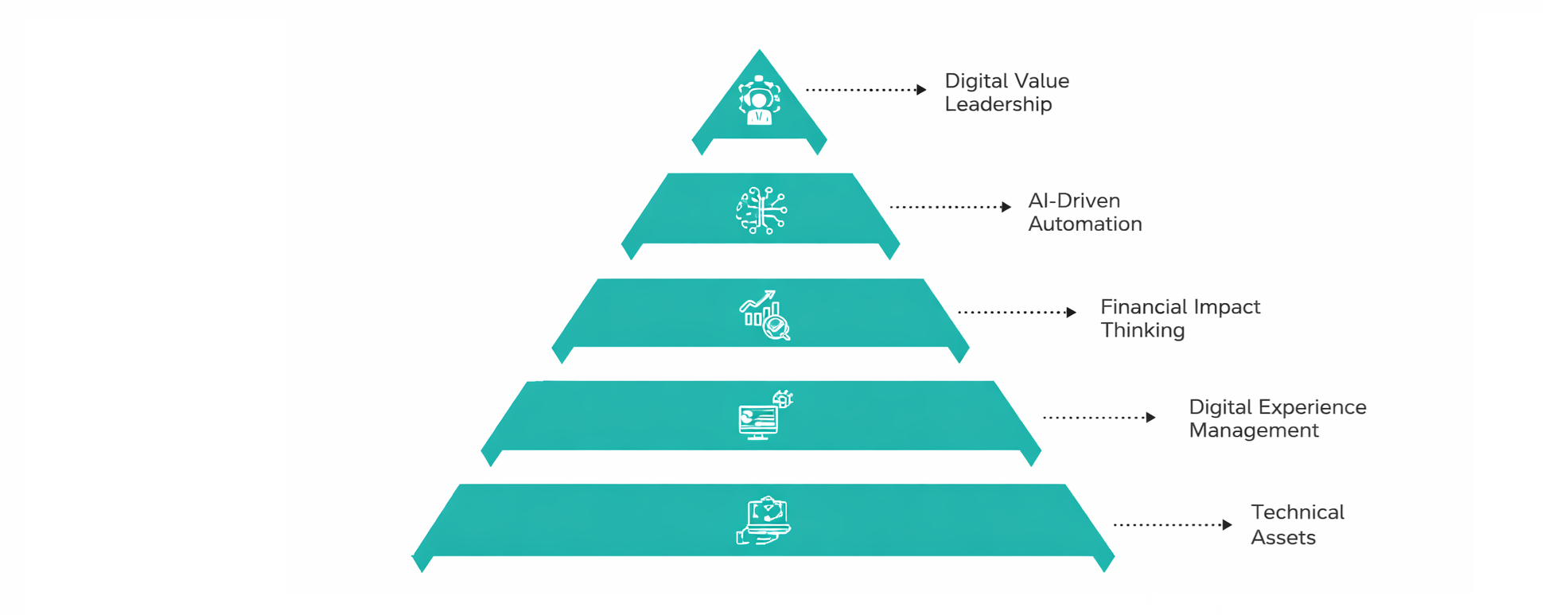
First strategy shift: From “Incident Resolution” to “Digital Experience Management” 
Layout
Half Width
Description

In 2026, IT RUN is no longer evaluated only on technical stability — it is accountable for measurable financial exposure. The organization must quantify, report, and actively manage the economic impact of technology disruptions, and also closely demonstrate the contribution of its digital platforms to the company’s financial results. 

â—Ź Calculating the cost of outage per minute: Calculate the revenue per minute for each critical digital channel, average transaction value and volume per minute, Measure production loss in manufacturing environments (units/hour), Estimate SLA penalties owed to clients due to downtime, Include reputational impact indicators (customer churn %, lost conversions). 

â—Ź Linking incidents to financial KPIs: Classify incidents by business domain (Sales, Supply Chain, Finance), Associate incident severity with estimated financial impact, Track cash flow delays caused by ERP or billing interruptions, Measure the cost of emergency changes (involving overtimes for production teams and unplanned costs) vs planned changes. 

â—Ź Thinking of IT RUN as a Contributor to company’s revenue Protection: Quantify avoided losses through proactive incident prevention, quantify the optimized infrastructure cost through performance tuning and move-to-cloud strategies, calculate vendor penalty exposure via strong licensing governance using the appropriate tools. 

â—Ź Adopting a Technology Business Management (TBM) Mindset: Translate technical services to business services (For example: No longer considering a “Payment API”, but rather “Order-to-Cash Service”), Measure the Total Cost Of Ownership (TCO) per application/service, Align and invoice application/services costs to the business units consuming them. 

Title
Second strategy shift: From “Cost Center logic” to “Financial Impact thinking”
Layout
Half Width
Description

In 2026, IT RUN cannot scale effectively without automation and artificial intelligence embedded into its core operating model. As system complexity increases and user expectations move toward real-time responsiveness, manual incident handling and reactive monitoring become operational bottlenecks. Automation is no longer a productivity improvement initiative - it is a structural requirement for stability, efficiency, and proactive service management. 

â—Ź AIOps for predictive incident detection : Use machine learning to identify anomalies before they impact users and trigger automated alerts or remediation 

â—Ź Self-healing infrastructure: Automate automatic restart, failover, scaling, and configuration rollback without human intervention

â—Ź Automatic incident classification: AI-assisted ticket classification, prioritization, and assignment to reduce response time. 

â—Ź Automation of repetitive tasks: Automate patching, access provisioning, environment provisioning, and routine system checks. 

â—Ź Automation KPIs as performance indicators: Measure automation rate, percentage of incidents auto-resolved, and reduction in manual effort.


Title
Third strategy shift: From “Reactive Operations” to “AI-driven automation”
Layout
Full Width
Description

As IT RUN becomes directly linked to revenue, resilience, and business performance, leadership roles must evolve accordingly. The modern IT leader is no longer purely technical — He becomes a “Head of Digital Value” and must operate at the intersection of technology, finance, and business strategy, translating operational performance into measurable value. 

  • From technical manager to value leader: Shift focus from infrastructure supervision to business impact management, financial accountability, and strategic alignment with enterprise objectives. 

  • Communication with CFO & COO: Act as a bridge between IT operations and executive leadership by translating system performance, risks, and investments into financial and operational insights. 

  •  Data-driven decision-making: Base prioritization, investments, and improvements on measurable metrics such as revenue impact, cost efficiency, risk exposure, and experience indicators. 

  • Strategic storytelling through dashboards: Use executive dashboards to communicate performance trends, financial exposure, and operational resilience in a clear and compelling way that supports strategic decisions.


Title
Fourth strategy shift: From “IT Manager” to “Head of Digital Value”
Layout
Full Width
Description
test
Title
IT RUN as strategic function in 2026
Pillars Wysiwyg

Organizations that shift from SLA-centric management to value-driven operations — powered by digital experience management, financial impact thinking, AI-driven automation, and strong value leadership — will transform IT RUN into a competitive advantage. 

The future belongs to companies that treat technology operations not as a cost to control, but as a business asset to optimize, protect, and scale.

Text

In 2026, IT RUN is no longer a hidden operational function measured by uptime percentages and ticket resolution time. It has become a strategic capability that directly influences revenue generation, customer experience, financial performance, and enterprise resilience. 

Overline
Conclusion
Read Time
10 min
Formatted Title

Why IT RUN becomes a Strategic Function in 2026 

Text

INTRODUCTION 
 

2026 marks the end of the perception of IT RUN as back-office, ticket-driven, reactive function, budgeted through a “cost center” model. 

The historical obsession with SLA (uptime %, response time, MTTR) should no longer be used as a performance measurement strategy, this article will explain why 2026 should mark a turning point. 

Contributors Section Title
Contributor
Inroduction Section Title
INTRODUCTION 
By azaghly , 6 March 2026
Listing Image
Evolution of Distributed Control Systems (DCS)
Article Body
Title

DCS as the Backbone of Process Industries

Description

For decades, Distributed Control Systems (DCS) have formed the operational backbone of continuous and batch processes within large-scale industrial automation and control systems . In oil refineries, power plants, mining operations, and water treatment facilities, DCS were designed to ensure deterministic control, high availability, and strict safety compliance.

Architecture emphasized redundancy, vendor-integrated components, and closed communication networks to minimize operational risk. In these environments, stability was prioritized over flexibility, reinforcing the role of DCS as mission-critical industrial control systems .

Data was primarily used for real-time control, alarms, and basic historical analysis, while higher-level optimization relied heavily on operator experience and engineering judgment. At this stage, process automation remained control-focused rather than intelligence-driven .

Image
Evolution of Distributed Control Systems (DCS)
Title

Process automation

Items
Description

Today, process industries face new pressures including fluctuating energy markets, stricter environmental regulations, aging assets, and growing demands for efficiency and transparency. These challenges expose the limitations of traditional, isolated DCS architectures within modern industrial automation systems.

To respond, industrial operators increasingly require end-to-end process visibility, real-time performance monitoring across multiple sites, predictive maintenance and asset health insights, and seamless integration with planning, maintenance, and energy management systems.

These evolving requirements have accelerated the convergence between DCS, IT systems, and digital platforms, reinforcing the role of DCS in broader digital transformation in industry strategies.

Title
Drivers of Change in Process Industries
Layout
Full Width
Layout
Full Width
Description

Modern Distributed Control Systems (DCS) architectures are evolving beyond pure control systems into foundational components of smart industrial systems. The adoption of Industrial Ethernet, open communication standards, virtualization, and OPC UA enables secure data exchange between control layers, edge systems, and enterprise applications.

In mining, oil & gas, and power generation, high-resolution process data generated by DCS feeds advanced analytics platforms for efficiency optimization, emissions reduction, and energy performance management. In water and utilities, data-driven DCS architectures support intelligent process automation, enabling leakage detection, energy optimization, and improved service reliability.

The DCS now acts as a trusted operational data source, bridging real-time industrial automation systems with analytics engines, digital twins, and decision-support platforms. This transformation reflects the emergence of industrial intelligence embedded within industrial automation and control systems.

Title
Interconnected and Data-Driven DCS Architectures
Layout
Full Width
Description

Increased connectivity introduces new risks, particularly in critical infrastructure environments. As a result, cybersecurity and resilience have become core design principles for modern industrial control systems and Distributed Control Systems (DCS). 

Network segmentation, secure remote access, role-based authorization, and continuous monitoring are essential to protecting operations while enabling digital integration. For process industries, maintaining safe and resilient operations remains non-negotiable, even as DCS evolve toward more open, interconnected, and Industry 4.0-ready architectures.

Title
Cybersecurity and Operational Resilience
Pillars Wysiwyg

For oil & gas, power generation, mining, and water sectors, this transformation positions the DCS not merely as an industrial control system, but as a cornerstone of digital transformation in industry, sustainable performance, and long-term industrial intelligence.

Selected Bibliography

IEC 62264 – Enterprise-Control System Integration
ISA-95 – Integration of Enterprise and Control Systems
OPC Foundation – OPC UA Specifications and Industrial Use Cases
Gartner – The Role of DCS in Industrial Digitalization

Text

The evolution of Distributed Control Systems (DCS) reflects a broader shift in process industries from isolated control toward interconnected intelligence. Modern DCS are no longer limited to executing control logic; they serve as strategic components of advanced industrial automation systems, enabling insight, optimization, and enterprise-wide decision-making.

Overline
Conclusion
Read Time
8 min
Formatted Title

Toward Interconnected and Data-Driven Architectures

Text

INTRODUCTION 
 

In process industries such as oil & gas, power generation, mining, and water utilities, Distributed Control Systems (DCS), as core industrial control systems within industrial automation systems, have long been synonymous with safety, stability, and continuous operation. However, increasing operational complexity, energy constraints, and digital transformation in industry initiatives are reshaping the role of DCS. Once isolated and control-centric, modern DCS are evolving into interconnected, data-driven architectures aligned with Industry 4.0, supporting advanced analytics, operational optimization, and enterprise-wide decision-making. 

This article explores this evolution and its implications for process industries operating within increasingly digital and intelligent industrial environments.

Contributors Section Title
Contributor
Inroduction Section Title
INTRODUCTION 
By admin , 2 March 2026
Listing Image
Teal
Article Body
Title

Reactive Cloud Operations in a Proactive World

Description

As organizations accelerate their adoption of hybrid cloud and multi-cloud infrastructure models, infrastructure management must evolve from a reactive, incident-driven approach to a proactive cloud infrastructure management strategy focused on resilience, performance optimization, cybersecurity, cost control, and measurable business value.
 

The Core Challenge: Reactive Cloud Operations in a Proactive World


Despite significant investments in cloud computing, virtualization, and infrastructure modernization, many organizations still operate in reactive mode. Cloud operations teams spend a large portion of their time resolving incidents instead of anticipating performance degradation, capacity constraints, or security vulnerabilities, which limits their ability to support digital transformation, scalability, and business growth.


In complex enterprise cloud infrastructure environments, reactive management increases operational risk, technical debt, and service disruption exposure.


A Shift in Mindset: From Reactive Operations to Proactive Hybrid Cloud Infrastructure Management


Proactive hybrid cloud infrastructure management treats cloud infrastructure as a strategic asset rather than a technical utility. It requires end-to-end visibility across on-premise infrastructure, private cloud, and public cloud platforms, supported by strong operational governance and advanced observability capabilities.


Modern cloud infrastructure management frameworks emphasize predictive analytics, automation, capacity planning, performance optimization, and proactive cybersecurity monitoring to anticipate and mitigate risks before they impact business-critical services.


Image
Teal
Title

Practical Approaches and Best Practices in Cloud Infrastructure Management

Items
Description

Defined roles, escalation paths, and structured decision-making processes reduce ambiguity and improve responsiveness in hybrid cloud environments. Mature cloud governance models improve operational efficiency and reduce escalation cycles and decision latency, strengthening overall cloud infrastructure resilience.

Title
Strong cloud governance and clear ownership
Layout
Full Width
Description

Beyond real-time alerts, advanced cloud observability tools analyze performance patterns, infrastructure utilization, workload behavior, and weak signals to prevent service degradation before users are impacted. IT service disruptions typically represent 5–10% of the annual operational impact within large enterprise IT environments, highlighting the strong business value of predictive monitoring and early detection in cloud infrastructure operations.

Title
Proactive cloud monitoring and trend analysis
Layout
Full Width
Description

Metrics such as cloud service availability, mean time to recovery (MTTR), cybersecurity posture, cost efficiency, and infrastructure scalability provide more strategic value than purely technical indicators. Aligning cloud infrastructure KPIs with business outcomes can significantly reduce reactive incident handling and improve overall service availability and performance stability.

Title
Business-oriented cloud KPIs
Layout
Full Width
Description

Post-incident reviews, systematic root cause analysis, and continuous improvement frameworks are essential to prevent recurring disruptions and improve cloud operations maturity. Organizations with structured cloud incident management practices report a substantial reduction in recurring infrastructure issues and enhanced operational stability.

Title
Structured incident and problem management in cloud environments
Layout
Full Width
Description

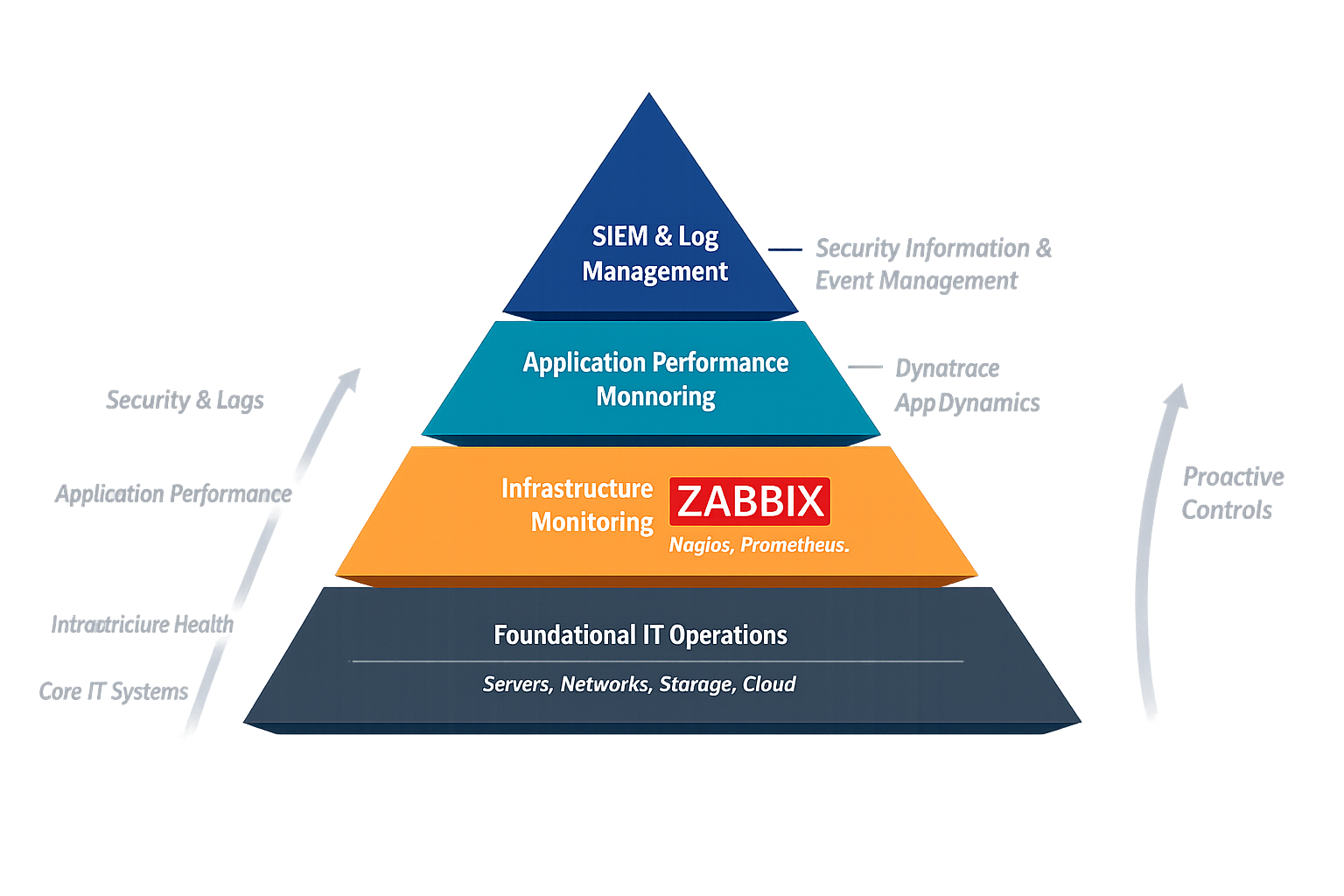
From a tooling perspective, proactive cloud infrastructure management is typically supported by a layered observability and monitoring architecture, integrating cloud monitoring platforms, infrastructure performance management tools, security information and event management (SIEM) systems, and automation frameworks. Each layer addresses specific operational needs across hybrid cloud ecosystems.

The Human-AI Collaboration Model
Title
The Human-AI Collaboration Model
Pillars Wysiwyg

Hybrid cloud success depends on operational maturity, not technology alone, within a well-structured cloud infrastructure strategy.

Proactive cloud infrastructure management reduces operational risk, enhances cybersecurity posture, improves scalability, and strengthens infrastructure resilience.

Monitoring, observability, automation, and cloud security tools must be aligned within a clear hybrid cloud governance framework to deliver sustainable performance excellence.

Text

Hybrid Cloud Infrastructure Management is no longer a purely technical function. It is a strategic enterprise cloud capability that directly influences business performance, operational resilience, cost optimization, and stakeholder confidence in cloud computing environments.

Overline
Conclusion
Read Time
10 min
Formatted Title

From Reactive Operations to Proactive Service Excellence

Text

INTRODUCTION 
 

Over the past decade, cloud infrastructure has become the critical backbone of modern business operations.

Enterprise applications, digital platforms, multi-cloud environments, and remote work ecosystems now depend on the continuous availability, performance, scalability, and security of increasingly complex hybrid cloud infrastructure architectures.
Contributors Section Title
Contributor