IT Service Management

By mmriki , 8 June 2026
Listing Image
From Cybersecurity
Article Body
Title

Building OT Cyber Resilience Through Defense in Depth

Description

Industrial environments are now more connected. Remote support is frequent, vendors are involved, and threats increasingly target production continuity. OT cybersecurity must therefore move from isolated measures to a structured resilience model.


This is the role of Defense in Depth. The objective is not to create a perfect barrier. The objective is to create coordinated layers so that if one control fails, another can prevent, detect, contain, or reduce the impact of an attack.


In OT, a cyber incident can affect more than data. A compromised engineering workstation can modify controller logic. A weak vendor account can open a path into the plant. Ransomware can stop production. A misconfigured firewall can expose SCADA servers. A missing backup can delay recovery.


This is why OT cybersecurity must combine anticipation, containment, monitoring, and recovery. It must also respect operational reality: legacy systems, vendor technologies, long asset lifecycles, safety requirements, availability constraints, and limited maintenance windows.


Image
Items
Description

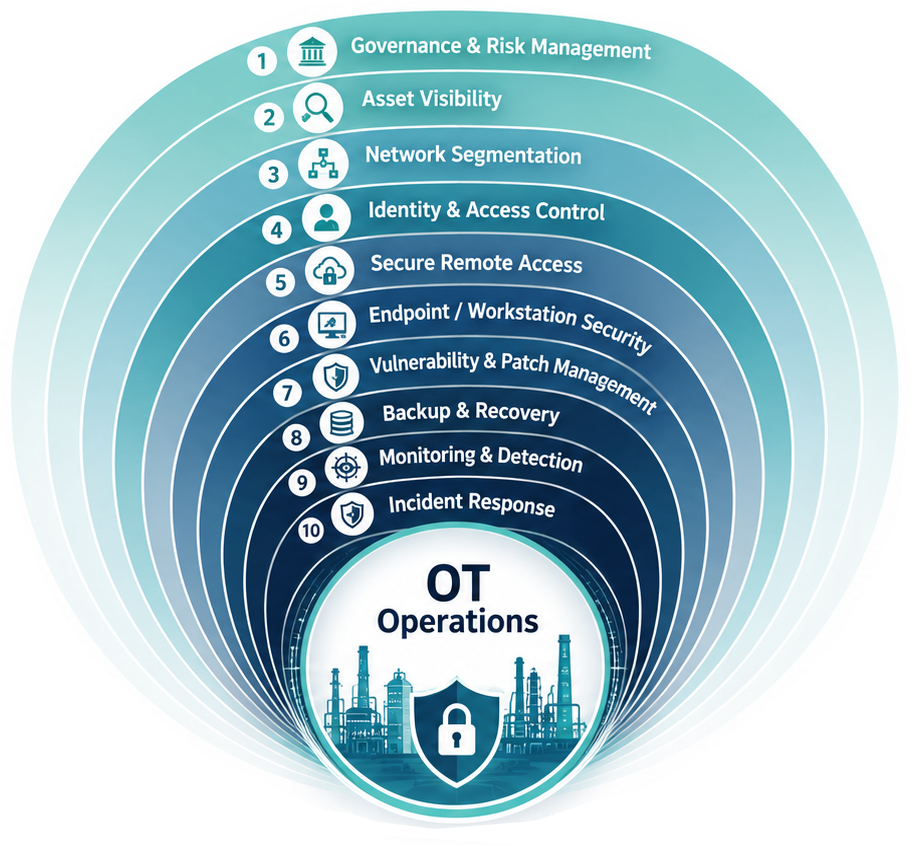
Separating IT and OT is still necessary, but the perimeter is no longer enough. Industrial systems now exchange data with historians, cloud platforms, remote vendors, patch servers, backup platforms, and monitoring tools. A mature model combines governance, asset visibility, segmentation, identity, remote access, endpoint protection, vulnerability management, backup, monitoring, and incident response.

Title
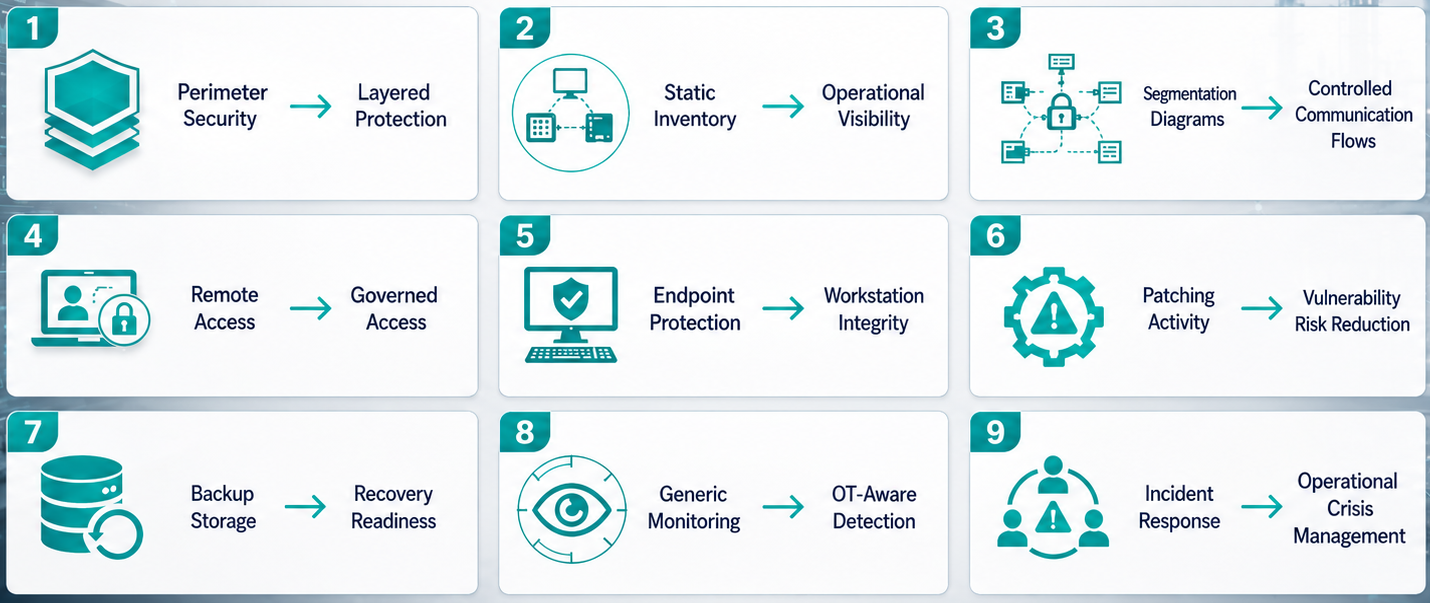
1. From perimeter security to layered protection
Layout
Full Width
Description

An inventory updated once a year cannot support real risk management. Organizations need visibility into connected assets, critical systems, normal flows, obsolete devices, vulnerable systems, engineering workstations, backup status, and monitored assets. Visibility transforms inventory from documentation into a security capability. Without visibility, decisions are based on assumptions. With visibility, they are based on facts.

Title
2. From static inventory to operational visibility
Layout
Full Width
Description

A network diagram does not protect an industrial environment. What matters is controlling which systems communicate, through which protocols, on which ports, and for which purpose. This is critical for SCADA, DCS, PLC networks, safety systems, engineering stations, historians, backup servers, patch servers, remote access platforms, and OT DMZs. The goal is to reduce propagation and limit the blast radius.

Title
3. From segmentation diagrams to controlled flows
Layout
Full Width
Description

Remote access is necessary for vendors, integrators, and internal teams, but it is also a major entry point. It must rely on named users, strong authentication, approvals, time-limited sessions, role-based permissions, jump servers, session recording, logging, access reviews, and SOC monitoring. Remote access must be approved, limited, monitored, and auditable.

Title
4. From remote access to governed access
Layout
Full Width
Description

Operator and engineering workstations are highly sensitive because they operate processes and modify controller logic. Protecting them requires more than antivirus. It requires control over administrator rights, USB usage, boot sequence, BIOS settings, application installation, OS hardening, patch levels, golden images, backups, physical access, change management, and security logging. The goal is to preserve the integrity of the industrial function.

Title
5. From endpoint protection to workstation integrity
Layout
Full Width
Description

Patching in OT is difficult because vendor validation, compatibility, rollback, safety, and maintenance windows must be considered. Vulnerability management should focus on risk reduction, not only patch deployment. Depending on the case, the right action may be to patch, isolate, monitor, restrict access, disable a service, or apply virtual patching.

Title
6. From patching to vulnerability risk reduction
Layout
Full Width
Description

Having backups does not guarantee recovery. The real question is whether the organization can restore the right systems, in the right order, within the required time, without additional risk. Recovery must cover servers, workstations, PLC programs, DCS configurations, safety logic, firewall rules, switch configurations, HMI projects, licenses, and documentation. Backups must be tested and procedures documented.

Title
7. From backup storage to recovery readiness
Layout
Full Width
Description

OT monitoring requires industrial context. A new RDP session, PLC programming activity, or communication change may be normal during maintenance but critical during production. Detection should focus on unauthorized engineering activity, remote access anomalies, controller logic changes, abnormal protocol behavior, lateral movement, firewall events, malware alerts, backup failures, patch failures, and configuration changes.

Title
8. From generic monitoring to OT-aware detection
Layout
Full Width
Description

An OT cyber incident can quickly become a production crisis. Response must involve cybersecurity, operations, maintenance, engineering, management, vendors, and communication teams. A strong plan defines leadership, escalation, vendor coordination, isolation authority, production decisions, restoration validation, executive communication, evidence handling, and restart approval.

Title
9. From incident response to crisis management
Layout
Full Width
Description
Title
OT Cybersecurity Maturity Roadmap
Pillars Wysiwyg

The future of OT cybersecurity will be defined by organizations that understand their assets, control their flows, govern access, monitor operations, and prepare recovery.

Text

Defense in Depth is not a technology stack, a checklist, or an accumulation of products. It is a structured way to protect industrial operations through coordinated and realistic layers.


Overline
Conclusion
Read Time
10 min
Formatted Title

Rethinking Defense in Depth for OT Environments

Text

INTRODUCTION 
 

For years, OT cybersecurity was treated as a list of controls: firewalls, antivirus, DMZs, USB restrictions, VPN access, and backups. These controls are useful, but they are not enough when deployed separately.

Contributors Section Title
Contributor
Inroduction Section Title
INTRODUCTION 
By admin , 10 March 2026
Listing Image
From SLA to Business Value
Article Body
Title

Why 2026 should mark a turning point ?

Description

SLAs measure stability, not business impact, which explains the famous syndrome of Businesses being suffering while all SLA dashboards are displayed in green. We can have 99.99% availability of an application for example, while businesses are encountering a poor user experience ! 


Companies should reconsider the new digital reality in 2026: IT is no longer a “support service” for the business, the Digital platforms become part of the business core. For example, Manufacturing operations rely on real-time MES and IoT monitoring to produce goods, E-Commerce platforms become revenue engines, and majority of bank transactions are executed through the core banking systems. Consequently, when we have an IT incident we are no longer talking about an “outage”, we are rather experiencing a revenue impact, thus making IT RUN inseparable from business performance. 


Technology failures are now visible at executive level: Minor latency or degradation can generate measurable losses, AI automation depends on stable and high quality data pipelines, and Cybersecurity incidents can carry reputational, regulatory and legal risks. 


Business leaders now expect IT RUN not merely to maintain system stability, but to actively safeguard revenue streams, enhance user experience, protect brand reputation, and directly contribute to measurable business outcomes

Image
Title

Strategy shifts

Items
Description

In 2026, IT RUN evolves from fixing incidents to actively managing digital experience and business perception. The focus is no longer limited to restoring service quickly - it is about ensuring users never feel disruption in the first place. 

â—Ź New technical indicators emerge, like transaction success ratespage load timesAPI response times

â—Ź Introducing Experience Level Agreements (XLAs) alongside traditional SLAs:

â—‹ Customer Satisfaction Score (CSAT): % of tickets rated 4/5 or 5/5, Monthly satisfaction score per application/service. 

â—‹ Effort & Friction metrics:, User effort score (response to question: How easy was it to resolve your issue ?), % tickets reopen rate 

â—‹ Business Impact metrics: Business Disruption Index (measure of incidents affecting business-critical IT services, weighted by criticality), % Availability of dashboards during financial closing periods, …

â—‹ Digital adoption metrics: Adoption rates of an application (Active users vs Licensed users), Self-Service analytics (% of services accessed with 0 support ticket needed)

â—‹ Proactive experience metrics: % of incidents resolved by automatic monitoring before users report, Incident recurrence rate (% of incident recurrently happening on a monthly basis), Number of recurring defects permanently eliminated 

Title
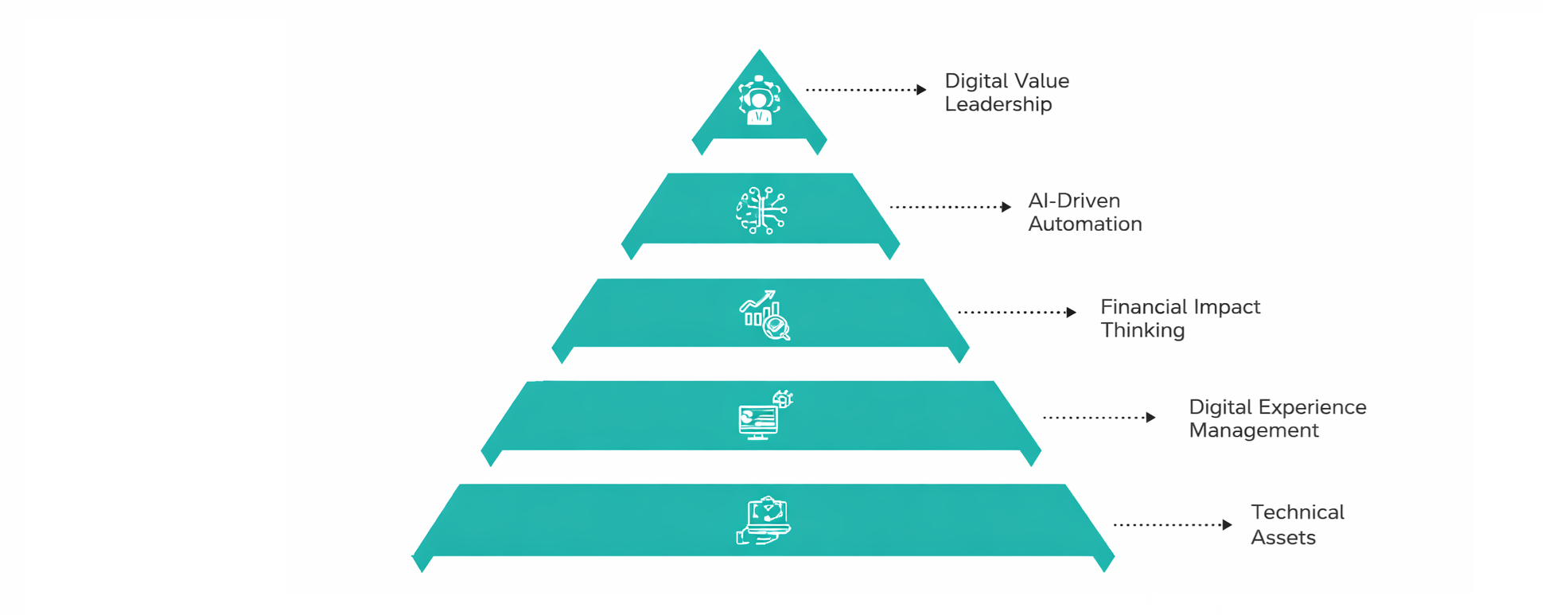
First strategy shift: From “Incident Resolution” to “Digital Experience Management” 
Layout
Half Width
Description

In 2026, IT RUN is no longer evaluated only on technical stability — it is accountable for measurable financial exposure. The organization must quantify, report, and actively manage the economic impact of technology disruptions, and also closely demonstrate the contribution of its digital platforms to the company’s financial results. 

â—Ź Calculating the cost of outage per minute: Calculate the revenue per minute for each critical digital channel, average transaction value and volume per minute, Measure production loss in manufacturing environments (units/hour), Estimate SLA penalties owed to clients due to downtime, Include reputational impact indicators (customer churn %, lost conversions). 

â—Ź Linking incidents to financial KPIs: Classify incidents by business domain (Sales, Supply Chain, Finance), Associate incident severity with estimated financial impact, Track cash flow delays caused by ERP or billing interruptions, Measure the cost of emergency changes (involving overtimes for production teams and unplanned costs) vs planned changes. 

â—Ź Thinking of IT RUN as a Contributor to company’s revenue Protection: Quantify avoided losses through proactive incident prevention, quantify the optimized infrastructure cost through performance tuning and move-to-cloud strategies, calculate vendor penalty exposure via strong licensing governance using the appropriate tools. 

â—Ź Adopting a Technology Business Management (TBM) Mindset: Translate technical services to business services (For example: No longer considering a “Payment API”, but rather “Order-to-Cash Service”), Measure the Total Cost Of Ownership (TCO) per application/service, Align and invoice application/services costs to the business units consuming them. 

Title
Second strategy shift: From “Cost Center logic” to “Financial Impact thinking”
Layout
Half Width
Description

In 2026, IT RUN cannot scale effectively without automation and artificial intelligence embedded into its core operating model. As system complexity increases and user expectations move toward real-time responsiveness, manual incident handling and reactive monitoring become operational bottlenecks. Automation is no longer a productivity improvement initiative - it is a structural requirement for stability, efficiency, and proactive service management. 

â—Ź AIOps for predictive incident detection : Use machine learning to identify anomalies before they impact users and trigger automated alerts or remediation 

â—Ź Self-healing infrastructure: Automate automatic restart, failover, scaling, and configuration rollback without human intervention

â—Ź Automatic incident classification: AI-assisted ticket classification, prioritization, and assignment to reduce response time. 

â—Ź Automation of repetitive tasks: Automate patching, access provisioning, environment provisioning, and routine system checks. 

â—Ź Automation KPIs as performance indicators: Measure automation rate, percentage of incidents auto-resolved, and reduction in manual effort.


Title
Third strategy shift: From “Reactive Operations” to “AI-driven automation”
Layout
Full Width
Description

As IT RUN becomes directly linked to revenue, resilience, and business performance, leadership roles must evolve accordingly. The modern IT leader is no longer purely technical — He becomes a “Head of Digital Value” and must operate at the intersection of technology, finance, and business strategy, translating operational performance into measurable value. 

  • From technical manager to value leader: Shift focus from infrastructure supervision to business impact management, financial accountability, and strategic alignment with enterprise objectives. 

  • Communication with CFO & COO: Act as a bridge between IT operations and executive leadership by translating system performance, risks, and investments into financial and operational insights. 

  •  Data-driven decision-making: Base prioritization, investments, and improvements on measurable metrics such as revenue impact, cost efficiency, risk exposure, and experience indicators. 

  • Strategic storytelling through dashboards: Use executive dashboards to communicate performance trends, financial exposure, and operational resilience in a clear and compelling way that supports strategic decisions.


Title
Fourth strategy shift: From “IT Manager” to “Head of Digital Value”
Layout
Full Width
Description
test
Title
IT RUN as strategic function in 2026
Pillars Wysiwyg

Organizations that shift from SLA-centric management to value-driven operations — powered by digital experience management, financial impact thinking, AI-driven automation, and strong value leadership — will transform IT RUN into a competitive advantage. 

The future belongs to companies that treat technology operations not as a cost to control, but as a business asset to optimize, protect, and scale.

Text

In 2026, IT RUN is no longer a hidden operational function measured by uptime percentages and ticket resolution time. It has become a strategic capability that directly influences revenue generation, customer experience, financial performance, and enterprise resilience. 

Overline
Conclusion
Read Time
10 min
Formatted Title

Why IT RUN becomes a Strategic Function in 2026 

Text

INTRODUCTION 
 

2026 marks the end of the perception of IT RUN as back-office, ticket-driven, reactive function, budgeted through a “cost center” model. 

The historical obsession with SLA (uptime %, response time, MTTR) should no longer be used as a performance measurement strategy, this article will explain why 2026 should mark a turning point. 

Contributors Section Title
Contributor
Inroduction Section Title
INTRODUCTIONÂ