Title
Building OT Cyber Resilience Through Defense in Depth
Building OT Cyber Resilience Through Defense in Depth
Industrial environments are now more connected. Remote support is frequent, vendors are involved, and threats increasingly target production continuity. OT cybersecurity must therefore move from isolated measures to a structured resilience model.
This is the role of Defense in Depth. The objective is not to create a perfect barrier. The objective is to create coordinated layers so that if one control fails, another can prevent, detect, contain, or reduce the impact of an attack.
In OT, a cyber incident can affect more than data. A compromised engineering workstation can modify controller logic. A weak vendor account can open a path into the plant. Ransomware can stop production. A misconfigured firewall can expose SCADA servers. A missing backup can delay recovery.
This is why OT cybersecurity must combine anticipation, containment, monitoring, and recovery. It must also respect operational reality: legacy systems, vendor technologies, long asset lifecycles, safety requirements, availability constraints, and limited maintenance windows.
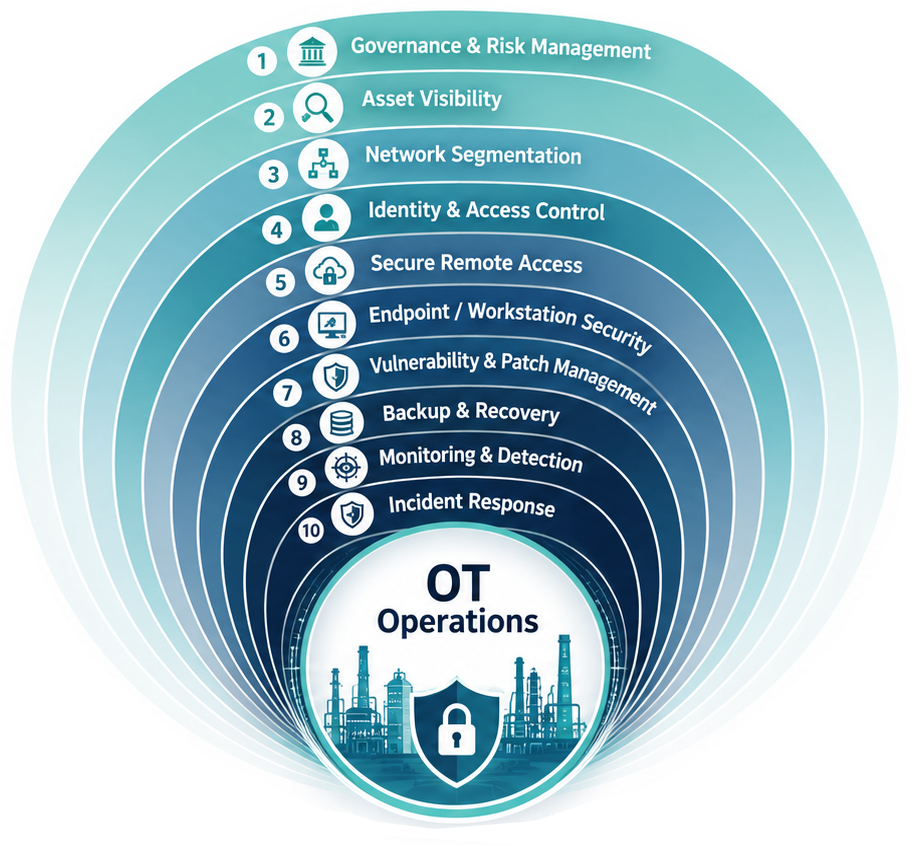

Separating IT and OT is still necessary, but the perimeter is no longer enough. Industrial systems now exchange data with historians, cloud platforms, remote vendors, patch servers, backup platforms, and monitoring tools. A mature model combines governance, asset visibility, segmentation, identity, remote access, endpoint protection, vulnerability management, backup, monitoring, and incident response.
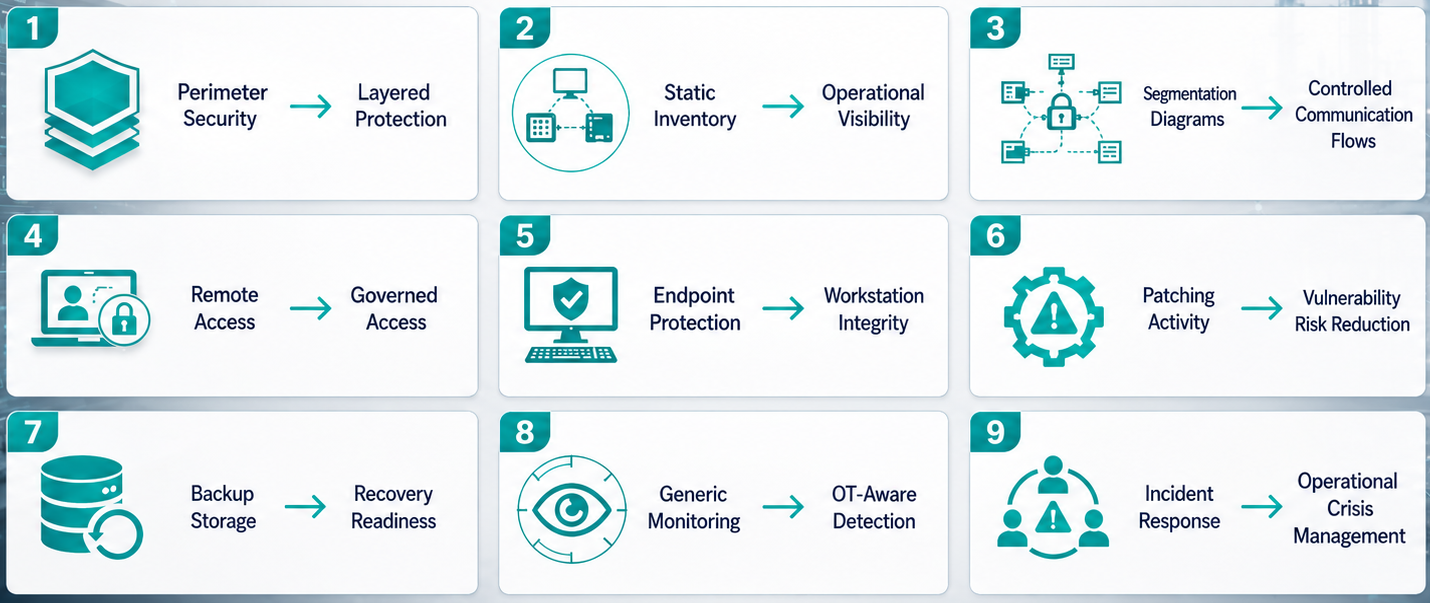
An inventory updated once a year cannot support real risk management. Organizations need visibility into connected assets, critical systems, normal flows, obsolete devices, vulnerable systems, engineering workstations, backup status, and monitored assets. Visibility transforms inventory from documentation into a security capability. Without visibility, decisions are based on assumptions. With visibility, they are based on facts.
A network diagram does not protect an industrial environment. What matters is controlling which systems communicate, through which protocols, on which ports, and for which purpose. This is critical for SCADA, DCS, PLC networks, safety systems, engineering stations, historians, backup servers, patch servers, remote access platforms, and OT DMZs. The goal is to reduce propagation and limit the blast radius.
Remote access is necessary for vendors, integrators, and internal teams, but it is also a major entry point. It must rely on named users, strong authentication, approvals, time-limited sessions, role-based permissions, jump servers, session recording, logging, access reviews, and SOC monitoring. Remote access must be approved, limited, monitored, and auditable.
Operator and engineering workstations are highly sensitive because they operate processes and modify controller logic. Protecting them requires more than antivirus. It requires control over administrator rights, USB usage, boot sequence, BIOS settings, application installation, OS hardening, patch levels, golden images, backups, physical access, change management, and security logging. The goal is to preserve the integrity of the industrial function.
Patching in OT is difficult because vendor validation, compatibility, rollback, safety, and maintenance windows must be considered. Vulnerability management should focus on risk reduction, not only patch deployment. Depending on the case, the right action may be to patch, isolate, monitor, restrict access, disable a service, or apply virtual patching.
Having backups does not guarantee recovery. The real question is whether the organization can restore the right systems, in the right order, within the required time, without additional risk. Recovery must cover servers, workstations, PLC programs, DCS configurations, safety logic, firewall rules, switch configurations, HMI projects, licenses, and documentation. Backups must be tested and procedures documented.
OT monitoring requires industrial context. A new RDP session, PLC programming activity, or communication change may be normal during maintenance but critical during production. Detection should focus on unauthorized engineering activity, remote access anomalies, controller logic changes, abnormal protocol behavior, lateral movement, firewall events, malware alerts, backup failures, patch failures, and configuration changes.
An OT cyber incident can quickly become a production crisis. Response must involve cybersecurity, operations, maintenance, engineering, management, vendors, and communication teams. A strong plan defines leadership, escalation, vendor coordination, isolation authority, production decisions, restoration validation, executive communication, evidence handling, and restart approval.
The future of OT cybersecurity will be defined by organizations that understand their assets, control their flows, govern access, monitor operations, and prepare recovery.
Defense in Depth is not a technology stack, a checklist, or an accumulation of products. It is a structured way to protect industrial operations through coordinated and realistic layers.
Rethinking Defense in Depth for OT Environments
For years, OT cybersecurity was treated as a list of controls: firewalls, antivirus, DMZs, USB restrictions, VPN access, and backups. These controls are useful, but they are not enough when deployed separately.